
For Today & Tomorrow
The Complete System
For Performance & Longevity


 Shop
Shop
 Learn
Learn


Editorial Team
Want To Jump Ahead?
Lock in Limited Time OfferThe foods that naturally contain NMN deliver tiny amounts. The human trials driving the longevity buzz are testing 250 mg, 600 mg, and even 900 mg a day. That explains why NMN has become such a fixation: not because it shows up in tomato or avocado, but because researchers think it may help restore NAD+, a cellular fuel source tied to energy production and how the body handles stress over time.
NMN stands for nicotinamide mononucleotide. It is a precursor to NAD+, a coenzyme your cells need for metabolic activity. Put simply, NAD+ helps cells turn nutrients into usable energy and supports repair systems that keep tissues functioning under pressure. That is why NMN gets pitched as a longevity supplement. The logic is straightforward: if NAD+ availability falls with age, then topping up one of its building blocks might help the system run better.
NMN has earned real scientific attention because the research is no longer just hypothetical. Human trials have shown that it can increase blood NAD+ and may support targeted outcomes linked to metabolic health and physical function. Even so, as Vinten, Trętowicz, Coskun and colleagues wrote in their 2025 Nature Metabolism review, the clinical evidence is still developing, which is why the most credible way to talk about NMN is with optimism, not overstatement.
The first thing to get straight is that NMN is not NAD+. It is one step upstream. Your body uses NMN in the salvage pathway that helps rebuild NAD+, which matters because oral NAD+ itself is a different proposition from taking a precursor that the body may convert and use. That biochemical detail is dry on paper, but it is the reason NMN became a serious category instead of staying a niche compound buried in a textbook.
NAD+ has become such a fixation because it does a lot. Researchers have tied it to mitochondrial energy production, cellular stress responses, and repair mechanisms that become more important as tissues age. In recent years, that has turned NAD+ from a biochemistry term into a wellness obsession. Scientists, however, are still trying to answer the more important question: Does increasing NAD+ in humans translate into changes people can actually feel or measure in a meaningful way?
That question matters because the human evidence is more uneven than the hype suggests. In a 2025 Nature Metabolism review, Kasper Vinten, Maria Trętowicz, and colleagues wrote that age-related NAD+ decline has been shown consistently in only a limited number of human studies and that clinical trials of NAD+ precursors have shown limited efficacy so far. That is not a takedown of NMN. It is a reality check from researchers who know the field best.
The cleanest finding so far is that oral NMN can raise blood NAD+. In a 2022 randomized trial in Frontiers in Nutrition, Keisuke Okabe, Keisuke Yaku, Yoshiaki Uchida, and colleagues gave 30 healthy adults either a placebo or 250 mg of NMN per day for 12 weeks. The NMN group showed a significant rise in whole-blood NAD+, and the study did not find obvious safety issues over the trial period. That is not a miracle result, but it is a real one.
A larger 2023 dose-ranging trial in GeroScience pushed the question further. Lin Yi, Andrea Maier and colleagues randomized 80 healthy middle-aged adults to placebo or 300 mg, 600 mg, or 900 mg daily. Blood NAD concentrations rose significantly in all NMN groups, with stronger increases at the higher doses, and the study reported good tolerability across the trial. That matters because it moves the conversation beyond “does anything happen at all?” to “how much changes, and at what dose?”
The more interesting question is what those biochemical shifts mean in practice. Here, the evidence gets more specific.
In 2021, Yoshino et al. published one of the most cited human NMN papers in Science. They studied 25 postmenopausal women with prediabetes who were overweight or obese and gave them 250 mg a day for 10 weeks. The result was not a sweeping transformation of every health marker. It was narrower and more useful than that: NMN improved skeletal muscle insulin sensitivity and insulin signaling in that specific group. If you want one real-world example that makes the NMN story feel human rather than theoretical, this is the one to use. It is a targeted clinical signal in a population that actually needed metabolic help.
There are also early signs in physical function. In 2022, Masaki Igarashi and colleagues reported in npj Aging that 42 healthy older men taking 250 mg of NMN daily for 12 weeks saw blood NAD+ rise, alongside exploratory improvements in measures such as gait speed and grip strength. Then, in 2024, Masashi Morifuji, Seiichiro Higashi, Shukuko Ebihara and Masashi Nagata published a randomized placebo-controlled trial in GeroScience in 60 older adults. After 12 weeks of 250 mg daily, the NMN group showed higher blood NAD+, better 4-meter walking performance, and improvements in some sleep-quality measures. Both studies are intriguing because they push beyond blood markers into outcomes people recognize. But both are still relatively small.
Safety is part of the story too, especially in a category that loves to imply more is always better. In 2022, Yuichiro Fukamizu, Yoshiaki Uchida, Akari Shigekawa, and colleagues published a Scientific Reports study finding that 1250 mg of NMN once daily for up to four weeks was safe and well tolerated in healthy adult men and women, with no severe adverse events observed during the trial. That does not settle the long-term safety question, but it does give the field something more solid than anecdotes and supplement-forum folklore.
“Most clinically relevant outcomes were not significantly different between NMN supplementation and control.” — Zhang, Poon and Wong’s systematic review and meta-analysis of randomized trials.
That quote matters because it lands on the part most brands try to skate past.
In a 2024 systematic review and meta-analysis, Jiaqi Zhang, Eric Tsz-Chun Poon and Stephen Heung-Sang Wong pooled 12 randomized trials involving 513 participants. Their conclusion was blunt: NMN supplementation significantly increased blood NAD levels, but most of the outcomes people actually care about, glucose, lipids, physical performance and other clinical measures, were not significantly different from control overall. The authors also flagged risk-of-bias concerns across several of the included studies.
NMN has emerged as one of the more credible NAD+ precursors in healthy aging research, with early human studies showing that it can raise blood NAD+ levels and deliver encouraging signals in selected areas such as muscle insulin sensitivity and physical function. That makes it a serious ingredient to watch.
That is also the key distinction the current science is helping sharpen. Improving a biomarker can be an important first step, especially when that biomarker sits so close to cellular energy metabolism, but researchers are still working to understand how those changes translate into broader, lasting benefits for health, mobility, and recovery over time.
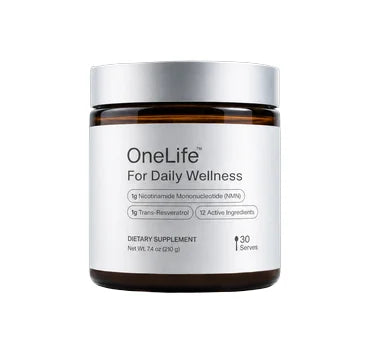
That is also the smartest way to think about a formula like OneLife. Not as a shortcut, but as a way to support the same systems this article is talking about every day. As part of a broader healthy aging routine built around sleep, training, diet quality, recovery, and consistency, the things that still carry the most weight when the hype gets stripped away.

For Longevity & Cellular Health
$3.90/day
$351/90 DAYS
NMN is best understood as a serious longevity research ingredient. It is a precursor to NAD+, a molecule deeply involved in cellular energy and repair. Human trials show that oral NMN can raise blood NAD+ and may improve certain targeted outcomes, including muscle insulin sensitivity in a specific metabolic group and some physical-function markers in older adults. That is enough to justify attention. It is not enough to justify fantasy.
For anyone building a long-game health routine, the smarter frame is not “Which capsule will save me?” It is “What supports the system I am already trying to protect?” Sleep, training, diet quality, recovery, and evidence-minded supplementation still do the heavy lifting. A premium formula like OneLife makes the most sense in that context: as part of a bigger routine built for consistency.
Get our weekly deep-dive into performance science, research summaries, and elite training protocols.
Join 45,000+ high-performers. Unsubscribe anytime.
Every batch of First or Nothing products is independently tested for heavy metals, purity, and dosage accuracy to ensure safety and quality.

First or Nothing is independently tested for heavy metals, purity, and dosage accuracy.
 OneFit®
OneFit®
OneFit®
OneFit®
OneFit®
OneFit®
OneFit®
OneFit®
OneFit®
OneFit®
OneFit®
First or Nothing is independently tested for heavy metals, purity, and dosage accuracy.
OneLife™
OneLife™
OneLife™
© 2026 FON Health AU Pty Ltd


Please select your shipping country.
Buy from the country of your choice. Remember that we can only ship your order to addresses location in the chosen country.

 Ships in 24h
"EXCELLENT"
 rated 4.8/5 on


