

For Today & Tomorrow
The Complete System
For Performance & Longevity


 Shop
Shop
 Learn
Learn


Editorial Team
Strength dips. Recovery drags. The waistline shifts. The usual advice is to walk more and eat less. The better question is whether the real problem is not effort, but the loss of muscle and bone happening underneath.
In Changes in Body Composition and Weight During the Menopause Transition, Gail Greendale and colleagues tracked women in the SWAN cohort and found that body composition starts shifting about two years before the final menstrual period. Fat mass accelerates upward, lean mass starts to fall, and by the time many women notice the change, it is already underway.
Menopause is still talked about as if it is mainly a hormone story with visible symptoms: hot flushes, sleep disruption, mood swings. What gets missed is what it does to tissue. Muscle is not just something that affects how you look in a singlet. It affects strength, balance, power, independence, and how resilient your body feels in everyday life.
Greendale et al. (2019) found that during the menopause transition, the average woman in SWAN did not simply gain fat. She also began losing lean mass. In their analysis, lean mass moved from a small gain in premenopause to a decline during the transition, while proportion fat mass rose by 3.6% and proportion lean mass fell by 1.9% over the course of the transition. That helps explain why so many women say some version of: “My weight has barely changed, but my body has.”
A second paper, Abdominal Visceral Adipose Tissue Over the Menopause Transition and Carotid Atherosclerosis: the SWAN Heart Study by Samargandy et al. (2021), found that visceral abdominal fat accelerated around two years before menopause as well, and that this menopause-related increase was associated with greater signs of subclinical carotid atherosclerosis. This is not just a cosmetic shift. The kind of fat increasing during midlife can be more metabolically concerning than the softer, more visible fat most women focus on.
That is why strength training matters more after 40, not less. When the body is being pushed toward less lean tissue and more central fat, lifting gives it a reason to keep muscle it might otherwise be more willing to lose. That is not a vanity goal. It is a protective one.
Bone loss does not wait until a woman is “elderly.” It speeds up right around menopause, and the timing alone should change how this stage of life is discussed.
The SWAN Fact Sheet on bone health reports that the rapid-loss phase starts about one year before the final menstrual period. Bone loss is fast for around three years, then continues more slowly in postmenopause. During that rapid-loss window, bone density falls by about 2% each year, and cumulative decline over 10 years is around 10%.
“During the period of fast loss, bone density declines on average about 2% each year.” — SWAN Fact Sheet: Bone Health over the Menopause Transition
That is the number many women never hear soon enough. Bone responds to load, and if bone is being lost faster during the menopause transition, then exercise needs to do more than simply burn calories. Bone needs load.
One of the clearest examples comes from Australia. In the LIFTMOR Randomized Controlled Trial, Steven Watson, Benjamin Weeks, Lisa Weis, and colleagues (2018) studied postmenopausal women with osteopenia or osteoporosis. One group completed eight months of twice-weekly, 30-minute, supervised high-intensity resistance and impact training. The other did a low-intensity home program. The lifting group improved lumbar spine bone mineral density by 2.9%, while the control group lost 1.2%. Femoral neck bone mineral density also performed better in the lifting group, and all functional performance measures improved. The trial reported only one adverse event, a minor lower-back spasm that led to two missed sessions.
That is a real example, with real numbers, and it matters because it cuts straight through one of the most common myths in this space: that postmenopausal women, especially those with low bone mass, should avoid challenging resistance work. The LIFTMOR researchers were careful about screening and supervision, but their results make one point very hard to ignore: intelligent lifting can be both effective and safe in the right setting.
The broader research is moving the same way. In a 2025 systematic review and meta-analysis, Fang Zhao and colleagues reviewed 17 randomized controlled trials involving 690 participants and found that resistance training significantly improved bone mineral density at the lumbar spine, femoral neck, and total hip. Their subgroup analysis suggested that programs at 70% of one-repetition maximum or higher, performed three times per week and carried out over longer durations, may be especially effective.
Many women hit menopause convinced their metabolism has suddenly fallen off a cliff. It feels true because the body often becomes less forgiving at exactly the same moment that muscle is harder to hold onto and fat distribution starts to change.
But the social-media version that menopause itself instantly “breaks” metabolism, is too simple. In 2023, Jari Karppinen and colleagues published Age But Not Menopausal Status Is Linked to Lower Resting Energy Expenditure in The Journal of Clinical Endocrinology & Metabolism. Their conclusion was that age was associated with lower adjusted resting energy expenditure, while menopausal status itself did not appear to make an independent contribution to that decline.
That does not mean women are imagining the change. It means the change is more about body composition and aging than a single dramatic metabolic switch being flipped overnight. And that is exactly why muscle retention matters so much in midlife. If the body is trending toward less lean mass, then preserving that tissue becomes one of the few levers women can still pull in a meaningful way.
This is where a lot of women get pushed in the wrong direction. They notice the scale, add more cardio, cut more food, and spend less time doing the one kind of training most likely to help. Cardio can support heart health and mood. It is just not enough on its own to answer muscle loss, bone loss, and the changing mechanics of midlife.
It does not have to be extreme, but it does have to be deliberate. Tiny weights forever, random circuits, and whatever machine happens to be free are not the same thing as progressive resistance training.
The women who tend to do best in this phase are usually not chasing exhaustion. They are building capacity. That means training patterns that ask the body to stay capable: squats, hinges, pushes, pulls, carries, step-based work, and enough progression to force adaptation over time.
LIFTMOR is useful here not because every woman needs to copy it exactly, but because it shows what a serious, practical program can look like. The intervention was brief, structured, and measurable: two 30-minute sessions a week, supervised, with progressive intensity. Zhao et al. (2025) point in the same direction at the meta-analysis level, suggesting that higher-intensity training done regularly is where a lot of the bone benefit sits.
For women new to lifting, the lesson is not “go heavy tomorrow.” The lesson is that the endpoint should be real resistance, not endless light effort. A body that is losing muscle and bone does not need more punishing randomness. It needs a clear signal to adapt.
And that is part of why strength training works so well psychologically in this stage. It gives women a different scoreboard. More load. Better form. Easier stairs. More confidence getting off the floor. Less sense that the body is becoming physically fragile. Those wins tend to feel a lot more useful than chasing a smaller number on the scale.
Menopause is not the moment to lower the physical stakes and expect less from your body. The evidence points the other way. Around menopause, muscles become more worth defending, bones become more sensitive to the right kind of load, and strength training becomes less of a fitness extra and more of a health decision.
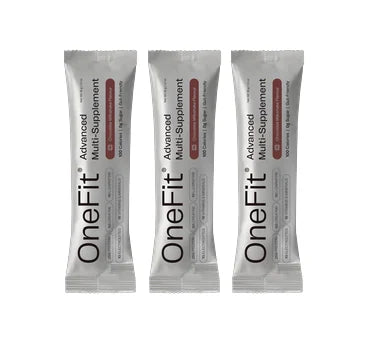
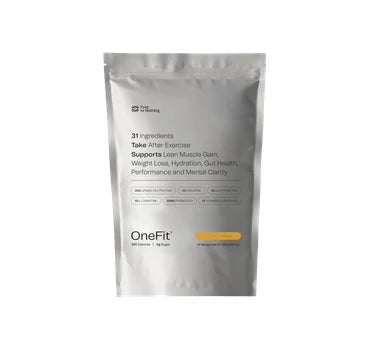
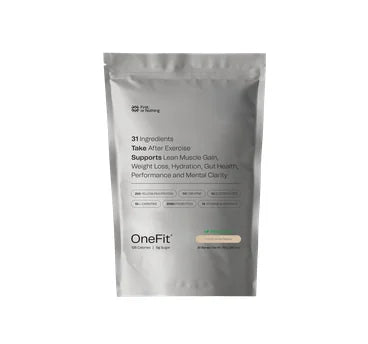
If the goal is to stay strong, keep training and make recovery easier to sustain, not more complicated. That is where a product like OneFit® fits best: not as a shortcut or substitute for lifting, but as a simpler way to cover the basics around consistency. OneFit® provides 25g protein, 5g creatine, 1g electrolytes, probiotics, and a broader nutrient stack in one daily serve.

For Performance
$3.30/day
$297/90 DAYS
Menopause is not the time to step back from strength training. It is the time to protect muscle, load bone properly, and train with enough intent to stay strong for the decades ahead. OneFit works best as support for that bigger goal, helping make recovery, protein intake, and daily consistency easier while the real work still happens in the gym.
Get our weekly deep-dive into performance science, research summaries, and elite training protocols.
Join 45,000+ high-performers. Unsubscribe anytime.
Every batch of First or Nothing products is independently tested for heavy metals, purity, and dosage accuracy to ensure safety and quality.

First or Nothing is independently tested for heavy metals, purity, and dosage accuracy.
 OneFit®
OneFit®
OneFit®
OneFit®
OneFit®
OneFit®
OneFit®
OneFit®
OneFit®
OneFit®
OneFit®
First or Nothing is independently tested for heavy metals, purity, and dosage accuracy.
OneLife™
OneLife™
OneLife™
© 2026 FON Health AU Pty Ltd


Please select your shipping country.
Buy from the country of your choice. Remember that we can only ship your order to addresses location in the chosen country.

 Ships in 24h
"EXCELLENT"
 rated 4.8/5 on


