
For Today & Tomorrow
The Complete System
For Performance & Longevity


 Shop
Shop
 Learn
Learn


Editorial Team
Want To Jump Ahead?
Lock in Limited Time OfferYou can be in bed for eight hours, hit what your wearable calls a “good” sleep score, and still wake up feeling like you have not recovered from yesterday.
That is the part people miss. The body does not just need unconscious time. It needs the right sleep stages, in the right order, for long enough that they can do their job.
Australia is not exactly crushing this. The Sleep Health Foundation reports that four out of 10 Australian adults get insufficient sleep on a daily or several-days-a-week basis, which helps explain why so many people move through the day tired, wired, and strangely unrefreshed.
The phrase everyone uses is “deep sleep.” It sounds like the hidden upgrade, the elite setting, the one thing missing from the average night. In reality, deep sleep matters for a reason, but it is not a mystical state you unlock with one capsule or one perfect wind-down routine. It is a stage your brain allows when the rest of the system is lined up properly.
Most people talk about sleep as if it were one long block. It is not. According to the National Heart, Lung, and Blood Institute, your body cycles through non-REM and REM sleep every 80 to 100 minutes, usually moving through four to six cycles a night. Deep sleep is stage 3 non-REM sleep, also called slow-wave sleep, and it tends to show up more heavily in the first half of the night, while REM becomes more prominent later on.
That explains why two people can both say they got “about six hours” and mean very different things. Someone who slept from 10:30 p.m. to 4:30 a.m. may have captured a decent amount of early-night deep sleep. Someone else who stayed up past midnight, slept restlessly, and woke repeatedly may get a much thinner version of the same total.
Deep sleep gets its reputation because it is closely tied to physical restoration. In 2022, Luciana Besedovsky, Maren Cordi, and colleagues published a human study in Communications Biology showing that when slow-wave sleep was experimentally enhanced during a 90-minute afternoon nap, growth hormone release rose and the autonomic nervous system shifted away from sympathetic predominance. That is a technical way of saying the body moved into a more recovery-friendly state, not just a more sedated one.
If you have ever been yanked awake by an alarm and felt almost sick with grogginess, you know this stage is different. Heart rate is lower. Blood pressure is down. Muscles are relaxed. The brain is not simply “off”; it is operating in a mode that supports the kind of restoration people usually try to chase with caffeine the next morning and supplements later that day.
That is also why “I slept” and “I recovered” are not interchangeable. You can log time in bed and still miss the payoff if your night keeps getting interrupted, compressed, or chemically distorted.
Recovery does not begin and end with what happens after training. It keeps going when the lights are off.
Besedovsky et al. did not only show a brain effect. Their 2022 paper linked deeper slow-wave sleep with shifts in endocrine and autonomic markers tied to metabolism, cardiovascular activity, and immunity. That helps explain why broken sleep can leave a person feeling flat even when food, training, and supplementation look fine on paper.
There is a mental side to this as well. Deep sleep is important, but it is not the only stage that matters. REM sleep becomes more dominant later in the night, so when sleep is cut short, the damage is not only less total sleep. The night itself becomes unbalanced.
That distinction matters in the real world. The high performer who brags about functioning on five hours may still be able to answer emails, lift weights, or get through meetings. Functioning is not the same as recovering.
One of the clearest examples comes from exercise research. In a 2021 systematic review and meta-analysis in Frontiers in Psychiatry, Yi Xie, Shuai Liu and colleagues pooled 22 randomized controlled trials and found that regular exercise improved self-reported sleep quality, insomnia severity, and daytime sleepiness. On average, Pittsburgh Sleep Quality Index scores fell by 2.19 points, and Epworth Sleepiness Scale scores fell by 2.55 points.
The enemies of deep sleep are often boring. They are also everywhere.
Light is one of them. In a 2022 systematic review with meta-analysis in Lighting Research & Technology, Christian Cajochen, Olivia Stefani, Isabelle Schöllhorn, Daniel Lang, and Satchinanda Panda Chellappa looked at evening electric light exposure and found that pre-sleep light can suppress melatonin and adversely affect subsequent sleep. The point is not that every bedside lamp is ruining your life. The point is that your brain reads evening light as biological information, and that information can push the system later than you think.
Alcohol is another classic sleep trap because it feels helpful in the moment. Carissa Gardiner and colleagues reported in a 2025 Sleep Medicine Reviews meta-analysis that alcohol delayed REM onset and reduced REM duration, with REM disruption showing up even after low doses of alcohol, defined as 0.50 g per kilogram or less, roughly two standard drinks. Higher doses shortened the time it took to fall asleep, but the trade-off was greater disruption to sleep architecture later in the night.
Irregular schedules do their own damage more quietly. The NHLBI advises going to sleep and waking up at roughly the same time each day, keeping the bedroom cool, dark, and quiet, avoiding electronic devices whose light can disrupt the sleep-wake cycle, and limiting caffeine, nicotine, and alcohol close to bedtime. None of that sounds revolutionary, which is probably why people ignore it.
That is where people often go wrong. They look for a dramatic intervention while keeping the low-level friction that keeps the brain alert at night: bright screens, late meals, shifting bedtimes, erratic wake times, and the idea that a glass of wine counts as winding down.
This is where sleep advice often goes off the rails. Supplements can help, but not in the way most marketing suggests.
Melatonin is the easiest example. It is often sold like a natural sedative, yet the evidence is far less convincing than the hype. In a 2022 Sleep Medicine Reviews paper, Kyungseon Choi, Yu Jeong Lee, and colleagues reviewed 24 randomized controlled trials and found that in adults with chronic insomnia, melatonin was not significantly effective for improving sleep onset latency, total sleep time, or sleep efficiency.
When sleep problems become chronic, the strongest clinical backing goes elsewhere. In 2021, Jack Edinger, J. Todd Arnedt, Suzanne Bertisch and colleagues published the American Academy of Sleep Medicine guideline recommending multicomponent cognitive behavioral therapy for insomnia, or CBT-I, as a first-line treatment for chronic insomnia disorder in adults. The same guideline also made clear that sleep hygiene should not be used as a stand-alone treatment.
That is the line worth holding. Supplements do not replace sleep architecture, and they should never be framed as though they do. But once the fundamentals are in place, the right formula can still create a meaningful advantage by helping the body recover better.
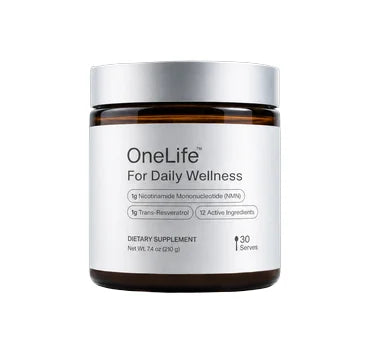
For a product like OneLife™, the advantage is that it answers the real problem, deep sleep is only part of recovery, and recovery still depends on what the body has available to rebuild, regulate stress, and function well the next day. First or Nothing positions OneLife™ as a daily longevity blend built around 1g NMN, 1g trans-resveratrol, 100mg CoQ10, 1,000mg elemental electrolytes, Aquamin magnesium, KSM-66 ashwagandha, L-theanine, B-vitamins, MCT for absorption, and an antioxidant complex in a single morning sachet.
OneLife™ does not “create” deep sleep on command. It is answering the bigger issue around deep sleep: the body still needs the right nutritional support for energy, recovery, hydration, stress resilience, and long-term health if you want the benefits of better sleep to actually show up in real life. Instead of asking people to juggle separate NMN, resveratrol, magnesium, CoQ10, and other pills on their own, OneLife™ turns that into one consistent daily habit

For Longevity & Cellular Health
$3.90/day
$351/90 DAYS
Deep sleep is not a mystery. It is the result of a system working properly, enough time in bed, protected early-night sleep, less evening light, less alcohol, more routine, regular movement, and a recovery plan that supports what the body is already trying to do overnight. That is where OneLife fits naturally into the story. Deep sleep creates the opportunity for repair, but better sleep is only part of the equation. Recovery still depends on what happens next, supporting stress resilience, cellular energy, hydration, and overall wellbeing the following day. OneLife helps turn that into one simple daily habit, making it easier to back up better sleep with the kind of consistent support most people struggle to piece together on their own.
Get our weekly deep-dive into performance science, research summaries, and elite training protocols.
Join 45,000+ high-performers. Unsubscribe anytime.
Every batch of First or Nothing products is independently tested for heavy metals, purity, and dosage accuracy to ensure safety and quality.

First or Nothing is independently tested for heavy metals, purity, and dosage accuracy.
 OneFit®
OneFit®
OneFit®
OneFit®
OneFit®
OneFit®
OneFit®
OneFit®
OneFit®
OneFit®
OneFit®
First or Nothing is independently tested for heavy metals, purity, and dosage accuracy.
OneLife™
OneLife™
OneLife™
© 2026 FON Health AU Pty Ltd


Please select your shipping country.
Buy from the country of your choice. Remember that we can only ship your order to addresses location in the chosen country.

 Ships in 24h
"EXCELLENT"
 rated 4.8/5 on


