

For Today & Tomorrow
The Complete System
For Performance & Longevity


 Shop
Shop
 Learn
Learn


Editorial Team
Want To Jump Ahead?
Lock in Limited Time OfferMost people read that and assume the solution is simple: drink a protein shake.
But watch what actually happens in real training life. Someone finishes a hard session, shakes their legs out, grabs protein, drinks water… and still wakes up feeling flat the next day. Not sore in a productive way, just depleted.
That gap between “I did everything right” and “I still feel under-recovered” is where most performance stalls begin.
Because recovery isn’t one system. It’s three running in parallel: rebuilding muscle tissue, restoring cellular energy, correcting fluid and electrolyte balance
Miss one, and the whole system slows down.
This is where protein, creatine, and electrolytes stop being “supplements” and start acting like biology.
Protein gets most of the attention in recovery, and for good reason. It supplies the amino acids needed to repair muscle damage created during training.
When you lift weights or sprint, you’re creating controlled disruption in muscle fibres. The body responds by rebuilding those fibres stronger — but only if it has enough raw material.
A landmark meta-analysis by Morton et al. (2018) in British Journal of Sports Medicine pooled data from 49 studies and found that protein supplementation significantly enhances gains in both muscle mass and strength during resistance training, particularly when total intake approaches ~1.6 g/kg/day.
But that’s where the common misunderstanding begins. Protein rebuilds structure. It does not restore energy.
So even if muscle repair is underway, you can still be functionally underpowered for your next session.
Every high-intensity rep runs on ATP, adenosine triphosphate, the body’s immediate energy source. The problem is that ATP stores are extremely limited. They deplete quickly and must be constantly regenerated.
That regeneration system depends heavily on phosphocreatine, which acts like a rapid backup battery.
This is where creatine becomes relevant in a way most people misunderstand. It’s not just about “strength gains.” It’s about how quickly you can restore usable energy between training sessions.
The International Society of Sports Nutrition position stand (Kreider et al., 2017, Journal of the International Society of Sports Nutrition) concluded that creatine monohydrate consistently improves high-intensity exercise performance and training adaptations across a wide range of populations.
In practical terms, this means: You don’t just perform more reps. You recover the ability to perform them again sooner.
A small but important distinction that changes how training compounds over time.
After training, most people instinctively reach for water.
But sweat loss is not just fluid loss. It is electrolyte loss — particularly sodium, which plays a central role in fluid retention and nerve-muscle signalling.
Without adequate sodium replacement, water moves through the system without being effectively retained where it is needed. That’s one reason people can drink a lot post-workout and still feel tired, light-headed, or cramp-prone.
The American College of Sports Medicine notes that dehydration equivalent to as little as ~2% of body mass can impair endurance performance and thermoregulation (Sawka et al., 2007, Medicine & Science in Sports & Exercise).
But hydration isn’t just about performance during exercise. It directly influences recovery efficiency because muscle repair and glycogen restoration depend on stable intracellular fluid balance.
So while protein rebuilds and creatine refuels, electrolytes make sure the system actually functions under the right conditions.
Recovery failure rarely comes from one missing nutrient. It comes from partial recovery across multiple systems.
Protein may be adequate, but energy restoration is lagging. Creatine stores may be supported, but hydration is off. Electrolytes may be replaced, but amino acids are insufficient.
And the body doesn’t prioritise equally; it compensates.
That compensation shows up as: slower strength progression, higher perceived fatigue, reduced training quality in subsequent sessions, longer “bounce-back” time between workouts
This is why athletes often describe being “in shape but not recovering.” Not a fitness problem. A systems problem.
There’s a useful way to think about it:
Protein is the construction crew. Creatine is the power supply. Electrolytes are the working environment.
If any one of those is missing, work continues, but inefficiently.
A practical example comes from strength athletes using structured supplementation protocols in training blocks. Research consistently shows that when creatine is combined with resistance training and adequate protein intake, lean mass and strength gains are greater than training alone (Kreider et al., 2017; Morton et al., 2018).
But the real-world effect athletes report is simpler: They don’t feel as “wrecked” between sessions.
That’s the adaptation advantage most people miss. Not just better output, better recovery between outputs.
The biggest issue in modern fitness isn’t a lack of effort. It’s a fragmented recovery.
People optimise protein but ignore hydration. They take creatine but under-eat protein.
They drink water but never replace electrolytes.
Each decision individually looks “healthy.” Together, they are incomplete.
And incomplete recovery compounds quietly over time. You don’t notice it in one session.
You notice it in month three when progress slows despite consistency.
That’s usually where people blame programming. But often, the issue is upstream.
When protein, creatine, and electrolytes are all supported together, recovery stops being something you hope is happening in the background.
It becomes something you can actually feel in the days that follow. Not in a dramatic way. There’s no single “moment” where everything clicks. It’s quieter than that.
But if you train regularly, you start noticing the pattern. Workouts don’t feel like isolated events anymore. They start to connect.
Muscle repair happens faster because amino acids are consistently available when the body is rebuilding tissue. This is the window shown in research by Phillips and Van Loon (2011), where muscle protein synthesis can remain elevated for up to 24–48 hours after training, but only if substrate is there.
Energy doesn’t crash in the same way between sessions either. Creatine supports the rapid recycling of ATP, meaning your body isn’t forced to fully “start from zero” every time you train again. Over time, that changes how much total work you can handle across a week, not just in a single workout (Kreider et al., 2017).
And then there’s the part most people ignore until it becomes a problem: hydration at the cellular level. When electrolytes like sodium and potassium are properly replaced, fluid balance stabilises faster, which supports both nerve signalling and muscle contraction efficiency. In plain terms, your body stops feeling like it’s playing catch-up the next day (Sawka et al., 2007).
None of these systems operate in isolation. They either recover together… or they all lag together.
And that’s the real shift, because once recovery is complete across all three systems, training stops feeling like a reset every time. It becomes cumulative. You’re not just surviving the next session; you’re building on the last one.
That’s the point where progress starts to look different. Strength trends upward more steadily. Fatigue feels more predictable. And the gap between “good sessions” and “bad sessions” starts to close.
At that stage, most people don’t need more effort. They need fewer missing pieces.
This is exactly where a system like OneFit® fits in.
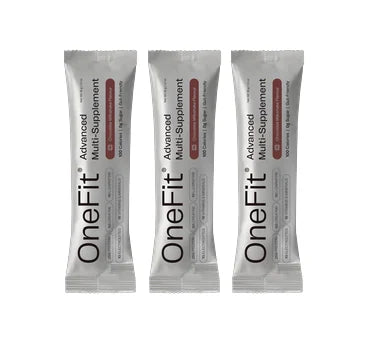
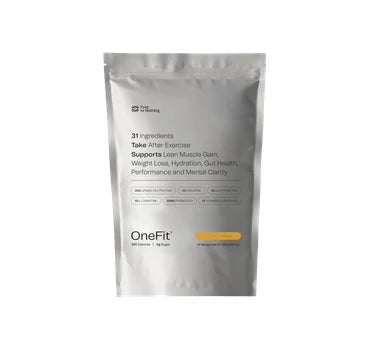
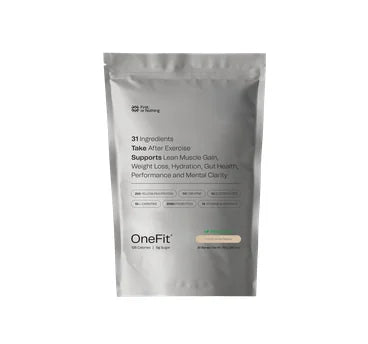
Instead of managing protein separately, timing creatine, and trying to replace electrolytes after the fact, OneFit® combines all three into a single daily serve protein, creatine, electrolytes, L-carnitine, vitamins, minerals, and gut support. Designed around the actual biology of recovery, not just isolated supplementation.
One system. One routine. No gaps between them.
Not because simplicity is trendy, but because recovery doesn’t work in fragments. It works as a system.

For Performance
$3.30/day
$297/90 DAYS
Recovery isn’t rest. It’s resource allocation. Protein repairs structure. Creatine restores energy. Electrolytes stabilise function; all three need to work together after training. Most people don’t need more training. They need a more complete recovery.
That’s where OneFit ® changes the recovery equation. A single daily serve that combines protein, creatine, and key electrolytes and minerals to support recovery without the guesswork or gaps.
When recovery is complete, progress stops resetting and starts compounding
Get our weekly deep-dive into performance science, research summaries, and elite training protocols.
Join 45,000+ high-performers. Unsubscribe anytime.
Every batch of First or Nothing products is independently tested for heavy metals, purity, and dosage accuracy to ensure safety and quality.

First or Nothing is independently tested for heavy metals, purity, and dosage accuracy.
 OneFit®
OneFit®
OneFit®
OneFit®
OneFit®
OneFit®
OneFit®
OneFit®
OneFit®
OneFit®
OneFit®
First or Nothing is independently tested for heavy metals, purity, and dosage accuracy.
OneLife™
OneLife™
OneLife™
© 2026 FON Health AU Pty Ltd


Please select your shipping country.
Buy from the country of your choice. Remember that we can only ship your order to addresses location in the chosen country.

 Ships in 24h
"EXCELLENT"
 rated 4.8/5 on


