

For Today & Tomorrow
The Complete System
For Performance & Longevity


 Shop
Shop
 Learn
Learn


Editorial Team
Want To Jump Ahead?
Lock in Limited Time OfferThen you try to carry groceries upstairs, and your legs feel weaker than they should.
This is the side of rapid weight loss that people do not talk about enough. GLP-1 medications can help people lose significant weight, but the body does not only lose “bad weight.” Depending on how you eat, train, and recover, some of that loss can come from lean tissue, the muscle and fat-free mass that helps keep you strong, mobile, and metabolically healthy.
The results are real. In the landmark STEP 1 trial, Wilding and colleagues reported in 2021 that adults taking once-weekly semaglutide 2.4 mg lost an average of 14.9% of body weight over 68 weeks, compared with 2.4% in the placebo group, alongside lifestyle intervention.
That trial helped change obesity medicine. It also raised a new question that matters for anyone using GLP-1, thinking about using one, or trying to maintain results after weight loss: when the number on the scale drops quickly, what exactly is being lost?
A STEP 1 body-composition analysis, published as an exploratory analysis in the Journal of the Endocrine Society, used DEXA scanning to look beneath the surface. The finding was encouraging but not simple: semaglutide reduced fat mass substantially, but lean mass also fell.
That does not mean GLP-1 medications are “bad for muscle.” It means the medication is only one part of the transformation. The habits around it decide whether weight loss leaves someone feeling stronger, flatter, more capable, or quietly depleted.
The goal is not to become a smaller, weaker version of yourself. The goal is to lose fat while keeping the muscle that lets you live well.
The scale is useful, but it is blunt. It cannot tell you whether the weight came from fat, water, glycogen, or lean tissue.
Two people can lose the same 10 kilos and end up with very different bodies. One is eating enough protein, lifting two or three times a week, sleeping properly, and keeping strength relatively stable. The other is barely eating, skipping training because energy is low, and celebrating the same scale drop while slowly losing the tissue that makes everyday life easier.
The difference is not willpower. It is structured.
The tirzepatide data tell a similar story. In the SURMOUNT-1 trial, Jastreboff and colleagues reported in 2022 that adults with obesity or overweight taking tirzepatide achieved substantial weight reduction over 72 weeks. A later SURMOUNT-1 body-composition analysis found that weight loss included both fat mass and lean mass, with fat mass accounting for a much larger share of the total reduction.
That is good news, but it is not a reason to ignore muscle. Even when most of the weight lost is fat, lean mass can still decline during large reductions in body weight.
This is where the conversation needs to mature. “How much weight did you lose?” is not the best question anymore. A better one is: what kind of weight did you lose?
Muscle matters far beyond the gym. It supports strength, glucose handling, posture, balance, training capacity and independence with age. Losing fat can improve health; losing too much muscle can make the result feel less powerful than it looks on paper.
GLP-1 medications can make eating less feel almost effortless. For many people, that is the breakthrough.
But a quieter problem often appears after the first few weeks. Meals get smaller. Protein portions shrink. Breakfast becomes coffee. Lunch becomes a few bites of salad. Dinner becomes half a plate because fullness arrives quickly.
The scale may keep rewarding the pattern, so it feels like success. But from the muscle’s point of view, the day may be underbuilt.
Protein is the raw material your body uses to repair and maintain lean tissue. During weight loss, especially when appetite is low, it becomes harder and more important to get enough consistently.
In the 2017 International Society of Sports Nutrition position stand, Jäger and colleagues stated that resistance exercise and protein ingestion both stimulate muscle protein synthesis and work synergistically when protein is consumed before or after resistance training. The same position stands that many exercising people benefit from about 1.4 to 2.0 grams of protein per kilogram of body weight per day, depending on context and goals.
That does not mean every person using a GLP-1 needs to eat like a bodybuilder. It means protein has to be planned rather than left to chance.
A practical example is when someone on a GLP-1 who feels full quickly may struggle with large meals. Instead of forcing a huge dinner, they may do better with smaller protein anchors across the day. Greek yoghurt or eggs in the morning, chicken or tofu at lunch, fish or lean meat at dinner, and a recovery option after training if appetite allows.
The principle is simple: do not wait until 8 pm to discover you have barely eaten any protein.
Protein gives the body materials. Resistance training gives them a reason to use them.
Walking is valuable. Cardio matters. Daily movement is a major part of metabolic health. But if the goal is muscle retention, progressive resistance training is the signal the body cannot easily ignore.
Sardeli and colleagues published a systematic review and meta-analysis in Nutrients in 2018 examining resistance training during calorie restriction in older adults with obesity. Their conclusion was direct: resistance training helped prevent muscle loss induced by caloric restriction.
That matters for GLP-1 users because these medications can create a calorie-restricted state quickly. If the body receives the message “less food is coming in, and no heavy work is required,” muscles can become easier to give up. If the body receives the message “we still need strength,” it has a stronger reason to preserve lean tissue.
This does not require a hardcore gym identity. Machines count. Dumbbells count. Resistance bands count. Bodyweight counts if the movement is challenging enough. Squats, hinges, rows, presses, carries, and lunges all send the same basic message: this tissue is still needed.
The important word is progression. The body adapts when the work gradually becomes more challenging over time — more reps, more load, better control, more range of motion or more total work. Doing the same easy circuit forever is better than doing nothing, but it is not the same as giving muscle a serious retention signal.
Protein and resistance training are strongest together. In a 2018 systematic review and meta-analysis in the British Journal of Sports Medicine, Morton and colleagues found that protein supplementation augmented gains in muscle mass and strength during resistance training in healthy adults.
For GLP-1 users, the takeaway is practical rather than extreme. Lift enough to tell the body muscle still matters, and eat enough protein to support the message.
A lower appetite can make people think their body suddenly needs less care. Usually, the opposite is true.
When food intake drops, there is less margin for poor sleep, low fluids, skipped meals, and chaotic training. The body may still be losing weight, but the person can feel flat, cold, tired, or weaker in sessions. That is not always a sign they need to quit training. Sometimes it is a sign that the plan is under-recovered.
Recovery starts with the pieces that sound basic because they are: sleep, hydration, enough protein, enough total nutrition, and training that challenges the body without turning every session into punishment.
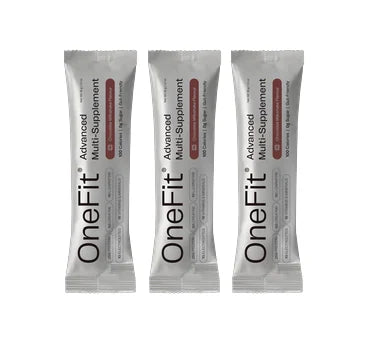
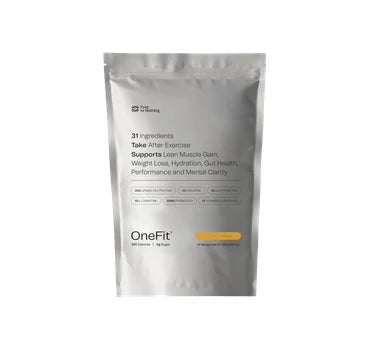
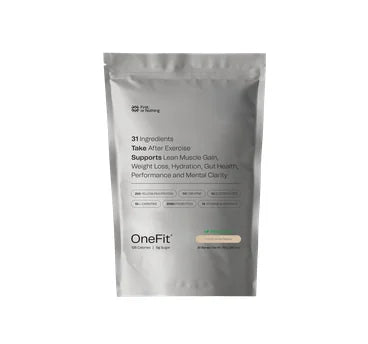
This is where OneFit® belongs in the plan, not as a replacement for protein, lifting, and definitely not as a promise that a supplement can preserve muscle on its own.
OneFit® fits as an easy daily support layer for people trying to protect strength while their appetite is lower. When meals feel smaller, energy feels less predictable, and routine starts slipping, the goal is to reduce the gaps that make muscle retention harder: inconsistent recovery, poor daily structure, missed hydration habits, and training that becomes harder to sustain.
That matters because nausea, constipation, or early fullness can make eating unpredictable for some GLP-1 users. A plan that depends on one huge evening meal may fail simply because the person cannot comfortably eat it. Smaller protein-rich meals, fluids earlier in the day, a realistic resistance-training schedule, and a simple recovery routine are usually easier to maintain.
OneFit® is positioned as part of the daily routine that helps make staying strong feel easier while the appetite is lower.
A useful checkpoint is strength. If body weight is dropping but lifts are collapsing, stairs feel harder, and energy is consistently poor, the plan may need adjusting. The goal is not to chase the fastest possible drop at any cost. The goal is a body that gets lighter without becoming less capable.

For Performance
$3.30/day
$297/90 DAYS
GLP-1 medications can help people lose weight at a level that once felt out of reach. But the better goal is not just a lower number.
It is a stronger result: less fat, better habits, preserved strength and a body that still performs when the scale is no longer the only thing being measured.
That is where OneFit ® earns its place in the routine. When appetite is lower, and meals feel smaller, OneFit offers an easy daily way to support the recovery and consistency that help keep strength in the picture.
Get our weekly deep-dive into performance science, research summaries, and elite training protocols.
Join 45,000+ high-performers. Unsubscribe anytime.
Every batch of First or Nothing products is independently tested for heavy metals, purity, and dosage accuracy to ensure safety and quality.

First or Nothing is independently tested for heavy metals, purity, and dosage accuracy.
 OneFit®
OneFit®
OneFit®
OneFit®
OneFit®
OneFit®
OneFit®
OneFit®
OneFit®
OneFit®
OneFit®
First or Nothing is independently tested for heavy metals, purity, and dosage accuracy.
OneLife™
OneLife™
OneLife™
© 2026 FON Health AU Pty Ltd


Please select your shipping country.
Buy from the country of your choice. Remember that we can only ship your order to addresses location in the chosen country.

 Ships in 24h
"EXCELLENT"
 rated 4.8/5 on


