


For Today & Tomorrow
The Complete System
For Performance & Longevity


 Shop
Shop
 Learn
Learn


Editorial Team
Want To Jump Ahead?
Lock in Limited Time OfferMaybe you need more grit.
Maybe you need a better program.
Maybe you need to push harder.
Or maybe the problem is sitting on your plate.
One of the most overlooked performance mistakes is not eating badly. It is eating “well” in a way that does not match the amount of work your body is doing.
This happens more often than people think. Someone cleans up their diet, cuts back on takeaway, swaps snacks for salads, adds protein, reduces carbs, trains harder, and feels proud of the new routine. For a while, it works.
Then the signs start creeping in. Flat sessions. Lingering soreness. Low motivation. Poor sleep. Hunger at odd times. A body that feels strangely resistant, even though the effort is there.
Sports scientists have a name for this mismatch: low energy availability. It means that once your training has taken its share of energy, there is not enough left for everything else your body still has to do: repair muscle, regulate hormones, support immunity, rebuild bone, restore glycogen, and keep your nervous system functioning properly.
Anne Loucks, Bente Kiens, and Hattie Wright explained this clearly in their 2011 review, Energy Availability in Athletes. Their key point was simple but important: for athletes and active people, the question is not just whether body weight is changing. The real question is whether enough energy remains after exercise to support normal physiology.
In other words, you can look healthy, eat healthy, and still be under-fuelled.
“You can eat clean and still eat too little to recover.”
Under-eating does not always look dramatic. It can look like Greek yoghurt and berries for breakfast, chicken salad for lunch, a banana before training, and salmon with vegetables at dinner. That is not a bad diet. For a sedentary person, it may be more than enough.
For someone lifting four days a week, doing intervals twice, walking 10,000 steps, working long hours, and trying to function on imperfect sleep, it may be a recovery problem disguised as discipline.
This is where calorie talk becomes too blunt. Your body does not only need energy to get through the workout. It needs energy after the workout so it can adapt to the stress you just created.
Training is not the result. Training is the signal.
The result happens later, when your body repairs tissue, restores fuel, builds strength, regulates hormones, and prepares you to go again. If that repair window keeps opening with too little energy available, performance eventually starts to slide.
The International Olympic Committee’s 2023 consensus statement on Relative Energy Deficiency in Sport, known as REDs, describes the problem as a mismatch between energy intake and exercise energy expenditure. REDs is not just about elite athletes, and it is not just about women. The IOC statement makes clear that low energy availability can affect both female and male athletes, with consequences across health and performance.
That does not mean every tired gym-goer has REDs. But it does mean the warning signs deserve respect.
If you are training hard and constantly feel flat, the answer may not be another coffee, another punishment session, or another supplement thrown at the wall. It may be more basic than that.
Your output went up.
Your intake did not.
Picture a 38-year-old woman who starts training for a half marathon while keeping her usual “healthy” weekday diet. She eats oats, salads, lean protein, vegetables and avoids dessert most nights. On paper, it looks excellent.
But her weekly running volume doubles. She adds strength training twice a week. She keeps carbs low because she wants to stay lean.
By week six, her easy runs feel hard. Her resting heart rate is higher. She is waking at 3 a.m. Her period becomes irregular. She assumes she is not fit enough and adds another session.
The issue is not that her food choices are poor. The issue is that her diet no longer matches the demand.
The same thing happens in the gym. A man chasing lean muscle may hit his protein target but still under-eat overall. He trains hard, avoids carbs at night, skips breakfast when busy, and wonders why his lifts stall. He is technically “high protein,” but his body is still short on total energy.
José Areta, Harry Taylor, and Karsten Koehler reviewed the evidence on low energy availability in a 2021 paper in the European Journal of Applied Physiology. They noted that low energy availability has been linked with endocrine, metabolic, and physiological changes, although the evidence varies depending on sex, duration, severity, and study design.
That nuance matters. This is not a panic article telling every active person to eat everything in sight. It is a warning against ignoring a pattern that many high-output people normalise.
Being sore after a hard session is normal. Feeling under-recovered for weeks is information.
Protein gets the applause. Carbohydrates often get suspicion. That is a problem for anyone doing demanding training.
Louise Burke, John Hawley, Stephen Wong, and Asker Jeukendrup made the case in their 2011 paper, Carbohydrates for Training and Competition. They explained that carbohydrate intake should be judged by whether it maintains enough carbohydrate substrate for the muscles and central nervous system during the exercise program, which means hard training needs usable fuel.
Your muscles store carbohydrate as glycogen. During higher-intensity work, heavy lifting, intervals, team sport, long runs, and repeated efforts, glycogen becomes a major fuel source. When it is low, the same session can feel harder than it should.
This is why people can be “eating clean” and still feel cooked.
A salad with grilled chicken may be nutrient-dense. It may also be a poor match for someone who trained legs that morning and has another session tomorrow. A low-carb dinner might fit a fat-loss plan, but it may not support the next day’s output if training demand is high.
Carbs are not automatically good or bad. They are context-dependent.
A rest day does not need to look like a brutal training day. A light walk does not need to be fuelled like a long run. But if you keep asking your body for high-output work while giving it low-output fuel, the bill eventually arrives.
That bill can look like poor performance, intense cravings, broken sleep, irritability, reduced training quality, or the strange feeling that your body is no longer responding to effort.
The fix is not always complicated. It may mean adding carbohydrates around harder sessions. It may mean eating breakfast before morning training instead of relying on caffeine. It may mean a more substantial dinner after a heavy day. It may mean stopping the habit of making every meal as light as possible.
For many active people, recovery improves when they stop treating food like something to minimise.
Under-fuelling rarely announces itself with one clean symptom. It usually shows up as a cluster.
Your workouts feel flat for no obvious reason. You are sore for longer. You dread sessions you used to enjoy. You feel cold more often. Your sleep gets lighter. You get sick repeatedly. Small injuries start appearing. Your mood dips. Your cravings become louder at night.
For women, menstrual changes are a major red flag. A missing, irregular, or unusually light period should not be brushed off as a normal badge of hard training.
For men, reduced libido, poor morning energy, stalled strength, and low drive can be clues that recovery is not keeping up. For everyone, the biggest clue is the trend.
One bad workout is normal. A bad week can happen. But a month of heavy legs, low energy, and poor recovery while training hard should make you look at fuel, not just effort.
A useful question is this: has your training increased while your eating stayed the same?
If the answer is yes, your “healthy routine” may be outdated. It may have worked for your old workload, but not for the one you are carrying now.
That does not mean abandoning standards. It means eating in a way that supports the body you are asking to perform.
More food is not always the answer, but enough food is non-negotiable. No supplement can replace a proper meal plan, enough sleep, or enough total energy.
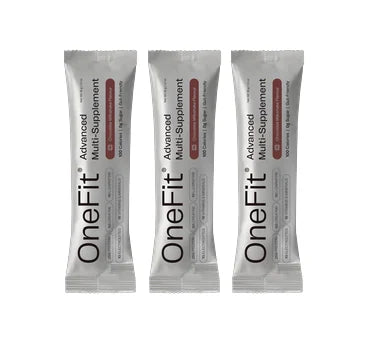
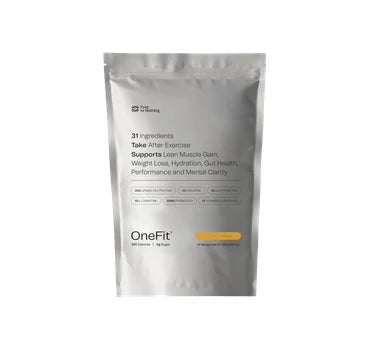
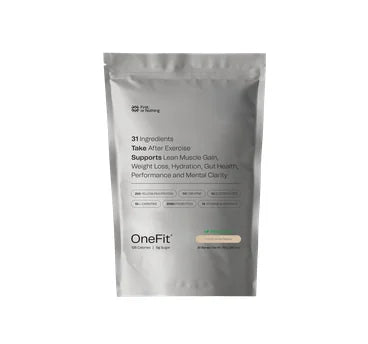
But once the foundation is in place, a smart recovery routine can make consistency easier. OneFit® is designed for people who train hard and struggle to juggle protein, creatine, electrolytes, and other basics. Simplicity matters. The plan you actually repeat will beat the perfect stack you forget three times a week.

For Performance
$3.30/day
$297/90 DAYS
If you are tired, flat, sore, and stuck, do not assume your body is failing you. It may be doing exactly what biology demands when training stress keeps rising, and fuel does not rise with it. Before you add more work, ask whether your body has enough energy to adapt to the work you are already doing. That is where OneFit ® fits naturally: not as a shortcut, and not as a replacement for real food, but as a simple daily recovery base for people who train hard and need consistency.
Get our weekly deep-dive into performance science, research summaries, and elite training protocols.
Join 45,000+ high-performers. Unsubscribe anytime.
Every batch of First or Nothing products is independently tested for heavy metals, purity, and dosage accuracy to ensure safety and quality.

First or Nothing is independently tested for heavy metals, purity, and dosage accuracy.
 OneFit®
OneFit®
OneFit®
OneFit®
OneFit®
OneFit®
OneFit®
OneFit®
OneFit®
OneFit®
OneFit®
First or Nothing is independently tested for heavy metals, purity, and dosage accuracy.
OneLife™
OneLife™
OneLife™
© 2026 FON Health AU Pty Ltd


Please select your shipping country.
Buy from the country of your choice. Remember that we can only ship your order to addresses location in the chosen country.

 Ships in 24h
"EXCELLENT"
 rated 4.8/5 on


